Nine Things a Manager Should Know About Their Business
Most managers are good at their function. They know marketing, engineering or finance. But surprisingly few can answer basic questions about how the actual business works.
Here are nine questions you should be able to answer. If you can't, that's fine. But then you know what to work on.
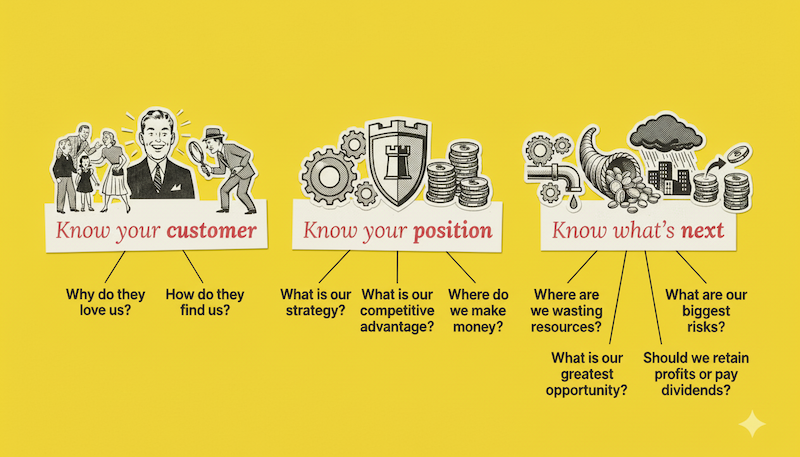
1. Why do our customers love us?
Not why they buy. Why they love us.
People buy because of price, convenience or habit. They love you because you solve something that matters to them in a way nobody else does.
April Dunford has a useful process for figuring this out. Start by listing what your customers would use if you didn't exist. Then figure out what you have that those alternatives don't. The key step most people skip: translate those unique attributes into outcomes. Nobody cares about your features. They care about what your capabilities do for their business.
Then ask: which customers care the most about those outcomes? The ones who would be terrified if you disappeared. That's where you focus.
If you can't answer this question clearly, you're probably marketing to the wrong people with the wrong message.
2. How do customers find us?
Think of this as a funnel. Many potential customers at the top. A few who actually buy at the bottom. Your job is to understand every step in between.
In B2B, it typically looks like this: marketing creates awareness (content, PR, SEO), which generates leads, which get qualified (do they have budget, authority, need and timing?), which leads to pitches, offers, negotiations and a deal. 60% of B2B sales end up in no decision at all, by the way. That's the real competition.
In B2C or product-led businesses the equivalent is: how do people discover us, what makes them try, and what makes them stay?
Two things matter. First, know which channels actually work for you (not in theory, in practice). Second, understand your conversion at each step. A small improvement in the middle of the funnel often beats a big investment at the top.
Your ad headline should talk about the thing the customer cares about. Not the thing you're proud of.
3. What is our strategy?
Most strategies are bad. They confuse goals with strategy. "We want to be the leading provider of X" is not a strategy. It's a wish.
Good strategy has three parts. A diagnosis: what's the core challenge we're facing right now? A guiding policy: what unique strengths can we use (speed, skills, scale, brand)? And a set of coherent actions that work together to address the challenge.
Strategy also looks different depending on where you are. Early stage: focus and speed. Do one thing, iterate, move fast. Growth stage: expand and standardise. Build on what works. Mature stage: manage a portfolio of bets. Prune what doesn't work, invest in what does.
The test of a good strategy: can you translate it into decisions this week? If not, it's probably just a PowerPoint.
4. What is our competitive advantage, if any?
The honest answer for most companies: we don't really have one. That's important to acknowledge, because it changes what you should do next.
A competitive advantage (or "moat") is something that protects you from competition over time. Hamilton Helmer outlines seven types: scale economies (being big makes you cheaper), process power (doing things in ways that are hard to copy), counter positioning (a new model incumbents can't follow without cannibalising themselves), branding (perceived value beyond what you objectively deliver), switching costs (making it painful to leave), network economies (more users = more value) and cornered resources (preferential access to something scarce).
Think about what forces are working against you too. How much power do your suppliers have? Can your customers switch easily? Could a new entrant replicate what you do with modern tech and no legacy costs? Are there substitutes? How fierce is the rivalry? An airline faces almost all of these headwinds. A pharma company faces almost none. That's why their margins are so different.
If you don't have a moat, your strategy should probably focus on building one. If you do, remember that moats erode. Success breeds confidence, confidence breeds complacency, and complacency is where competitors sneak in. We cover this in depth in our Competitive Advantages & Moats masterclass.
5. Where do we make money?
Most managers know top-line revenue. Far fewer can tell you where they actually make money. Which products, customer segments or geographies are profitable, and which ones are just creating activity?
The Pareto Principle is brutal here: 80% of your profit typically comes from 20% of your products or customers. Some of what you sell may actually be losing money once you account for the time and effort it takes to deliver it.
You need to understand your income statement. Not as an accounting exercise, but as a map. Revenue at the top, then cost of goods sold (gives you gross profit), then operating expenses (gives you EBITDA), then interest and taxes (gives you net profit).
If you sell multiple products or serve multiple segments, try to break this down per unit. Where is the gross margin highest? Where is it trending the wrong way? This is where the real decisions hide.
6. Where are we wasting resources?
Lean thinking has a useful framework: seven types of waste. Originally designed for manufacturing, but they apply everywhere.
Defects (work that needs redoing), overproduction (doing more than needed), waiting (blocked by something upstream), non-utilised talent (skilled people on low-skill tasks), transportation (moving things around unnecessarily), inventory (stockpiling more than you need) and motion (unnecessary steps in a workflow).
Beyond these, look at your calendar and your tech stack. How many meetings could be an email? How many emails could be a Slack message? How many SaaS subscriptions are you actually using? How many approval steps exist because of something that happened once, 3 years ago?
The best operators have a Kaizen mindset: continuous small improvements. Not a big reorg once a year. Constant trimming, every week. Or as one founder put it: the best thing you can do is subtraction.
7. What is our greatest opportunity right now?
There's a useful concept called "explore vs exploit". Most of your time should go to exploiting what already works. But roughly a third should be spent exploring, testing new things, looking for the next move.
Opportunities tend to come from a handful of places: dissatisfied customers (yours or someone else's), things moving online that weren't before, proven business models from other markets or industries, regulatory changes that open new doors, or add-on products to something you already sell. It helps to look at which segments are growing the fastest and where you have the best fit.
To evaluate what's worth pursuing, think in expected value: potential payoff times probability. A 10% chance at something 10x is worth more than a sure thing that moves the needle 5%.
But finding opportunities is the easy part. The hard part is choosing. Every decision to pursue one thing is a decision to skip something else. That opportunity cost is real even if it doesn't show up on any report.
8. What are the biggest risks to our business model?
Some risks are easy to spot: customer concentration (what if your biggest client leaves?), key person dependency (what if your best salesperson quits?), low margins with no clear path to improvement, high fixed costs that don't flex with revenue, and debt levels that leave no room for error.
Then there are the less obvious ones. Success itself is a risk. Being right breeds the confidence that you can't be wrong. Strategies that work at one scale break at another. Skills valuable in one era don't always transfer to the next. And some of what you call skill might just be luck (and luck reverts to the mean).
It's also worth stress-testing your position in the value chain. How dependent are you on a single supplier? Could a competitor cut you out by going direct to your customers? Could your customers cut you out by doing what you do themselves?
The best hedge against risk? Profitability. If you're profitable, you don't need external capital to survive. Cash gives you options. Debt takes them away.
9. Should we retain our profits or reinvest them?
Warren Buffett called capital allocation the CEO's most important job. His first rule: what's smart at one price is dumb at another.
The question is simple: can you put a dollar back into the business and get more than a dollar out? If yes, reinvest. If not, return it to owners or park it as cash for future opportunities.
Where you are matters. Early and growth-stage companies usually have plenty of high-return reinvestment options: more sales capacity, new products, new markets. Mature companies often don't, and that's when dividends start making sense.
The financing hierarchy matters too. Internal financing (reinvesting profits) is cheapest. Debt is next (you keep the upside but carry the risk). Equity is most expensive (you share both upside and control).
One more thing. Compounding is enormously powerful. The Rule of 72: if you're growing at 15% per year, you'll double in under 5 years. A small edge, maintained over time, turns into something very large. But only if you stay alive long enough to let it compound. Our compounding table makes this tangible.
The Pareto MBA will give you plenty of tools for answering these questions. Eight modules, eight weeks, everything you need to think like a general manager. Not sure yet? Start with MBA Essentials, our free 8-part email course.