Black swans
Rare, high-impact events that look obvious in hindsight but were unpredictable in advance.
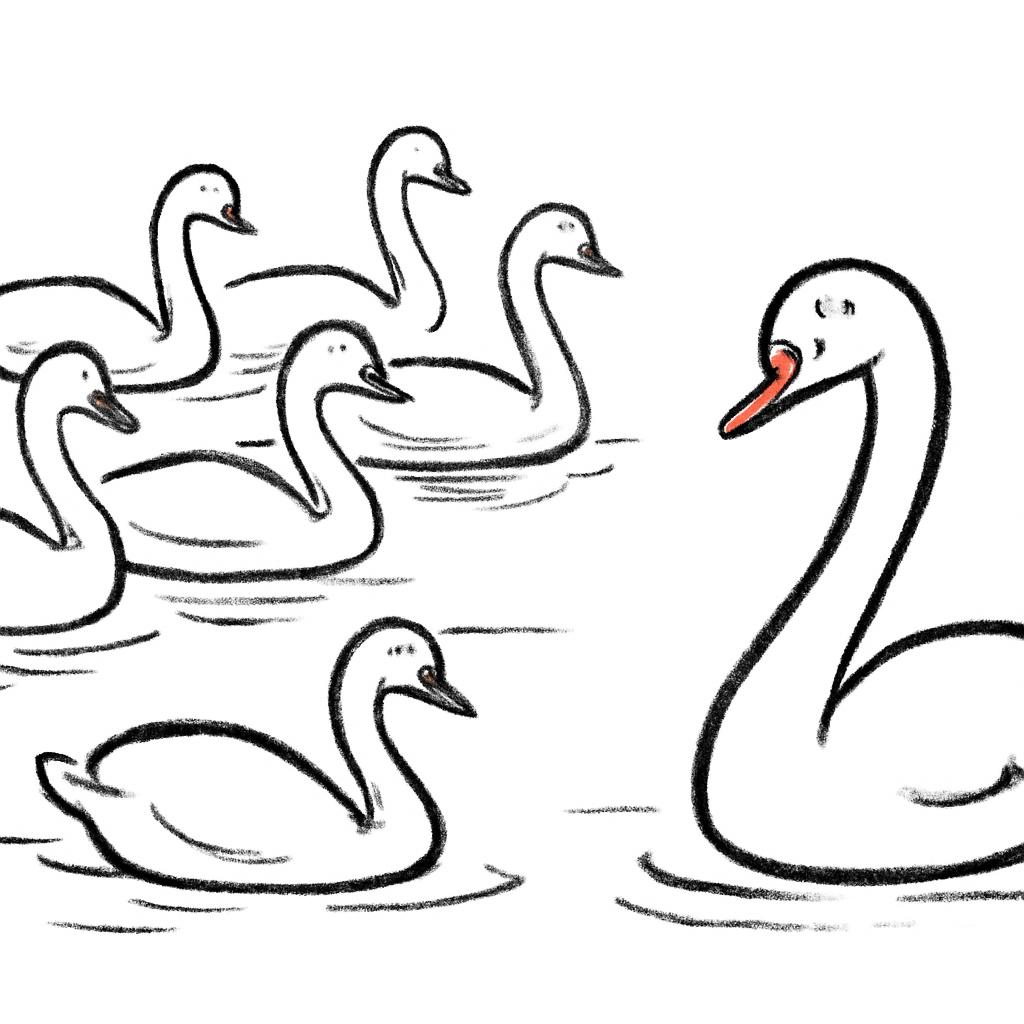
Nassim Taleb's book "The Black Swan" (2007) made the term famous, though the metaphor is older. Europeans assumed all swans were white because every swan they'd ever seen was white. Then they got to Australia and found black swans. The point: your model of the world is built on what you've observed, and what you've never observed can blow it up.
Taleb's definition has three parts: 1. The event is rare, outside normal expectations 2. The impact is extreme, changes everything 3. We rationalise it after the fact (oh of course this would happen)
The 2008 financial crisis, 9/11, COVID, the iPhone, the printing press. All black swans by this definition.
The mistake most operators make: planning as if the next year looks like this year. Most strategic plans assume the normal distribution of outcomes. They get hit by the rare ones.
There are two wrong responses. One is to ignore black swans entirely (most plans). The other is to try to predict the specific swan that will land (impossible by definition; if you can predict it, it's not a swan). The right move is to design for resilience without specifying the threat. Build margin of safety. Keep optionality. Don't take bets that can wipe you out, even when the expected value looks great. Black swans are asymmetric: a single bad one can erase decades of small gains.
Worth noticing: positive black swans exist too. The startup that becomes a unicorn. The drug that becomes a blockbuster. The career move that opens doors you didn't know existed. Plans that exclude positive black swans systematically miss the biggest upside.
Practical implications:
- Don't bet the company on any single forecast
- Hold real cash even when it looks lazy
- Be ready to act fast when the unexpected starts unfolding
- Don't over-optimise. A fragile system is one where any black swan kills you.
The Pareto MBA way of thinking about this: most career and business returns come from a few rare events. Plan to be there when they happen, on both the upside (so you can catch the good ones) and the downside (so you survive the bad ones).
Examples in the wild
Most airlines were caught with too much capacity and too little cash when COVID hit. Southwest had been hoarding cash for years and got mocked for it. Southwest survived best and bought assets at fire-sale prices.
Buffett's $150B+ cash pile is a black swan hedge. He gets criticised for 'underperforming' the market, but he's holding for the rare moments when great businesses are on sale. 2008, March 2020, the next one.
Insurance is rational because of black swans. Most years you don't need it. The year you need it, you really need it. The expected return is negative; the protection from a single bad event is the point.
Black swans is one of the mental models we apply through real cases inside the Pareto MBA — a part-time program for professionals who want to think clearly about business.