The flywheel
Sustainable growth comes from self-reinforcing loops, not from heroic individual efforts.
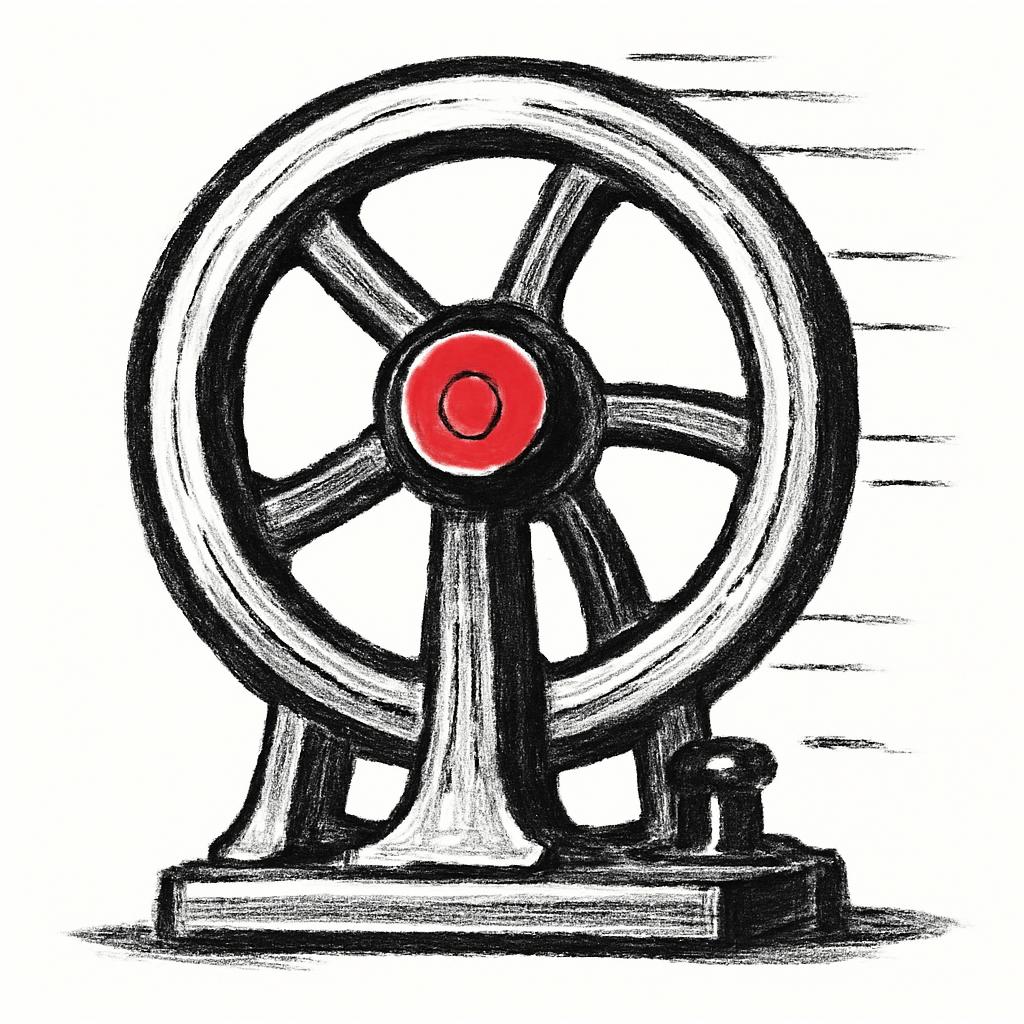
Jim Collins introduced the metaphor in "Good to Great" (2001). A flywheel is a heavy iron wheel mounted on a shaft. It's enormously hard to push from a standstill. You push, it moves an inch. You push again, it moves a foot. Eventually it's spinning so fast it generates its own momentum and almost nothing can stop it.
The point: every great company has a flywheel you can map out. Each step drives the next. The last step feeds back to the first. Once it's running, every push reinforces the whole loop.
The classic Amazon flywheel:
- Lower prices → more customers
- More customers → more volume for sellers
- More volume → more sellers want to be there
- More sellers → more selection
- More selection → more customers
- More customers → lower prices via scale
- (Repeat, forever)
Once a flywheel is spinning, growth becomes self-sustaining instead of effortful. The company stops having to push as hard. Each new push reinforces multiple parts of the loop.
What makes a flywheel work:
- Causal connections between steps (each step actually drives the next, not just correlates with it)
- A complete loop (the last step feeds back to the first)
- Compound effects (each cycle is bigger than the last)
What makes flywheels fail:
- Steps that aren't actually causal. "More users → more growth" only works if more users actually drive more new users. Correlation isn't enough.
- Open loops, where energy leaks out and doesn't feed back
- Missing the slow start phase. Almost every real flywheel feels hopeless for the first few years. The founders quit. The flywheel never gets to compound.
The deeper insight: most companies don't have a flywheel. They have what Collins called a "doom loop." Each push undoes the previous push. Acquire customers at a CAC higher than their LTV. Improve one feature while breaking another. Hire to fix problems that the new hires then create more of.
How to design or fix a flywheel:
- Start with the outcome you want (more revenue, more retention, lower CAC)
- Work backward to find what would drive it
- For each driver, ask what would drive that
- Continue until you find a self-reinforcing loop
- If you can't find one, you don't have a flywheel. You have a treadmill, and treadmills don't compound.
Flywheels are what separate sustainable from temporary growth. The temporary kind comes from spending more. The sustainable kind comes from a loop that gets stronger every time you push it.
Examples in the wild
Costco's flywheel: low prices → more members → bigger buying power → lower prices. The annual membership fee funds the low prices. Each new member makes the loop stronger. This is also why Costco's per-store revenue is 3-5x competitors.
Companies with working flywheels often have non-obvious metrics that reveal them. Member retention. Repeat purchase rates. Net revenue retention. The load-bearing metrics of the flywheel are what matter.
Personal flywheels exist too. Writing publicly → builds reputation → attracts opportunities → creates more to write about. Most durable careers have one running. Most stuck careers have a doom loop.
The flywheel is one of the mental models we apply through real cases inside the Pareto MBA — a part-time program for professionals who want to think clearly about business.