Chesterton's Fence
Don't tear down a fence until you know why it was put up.
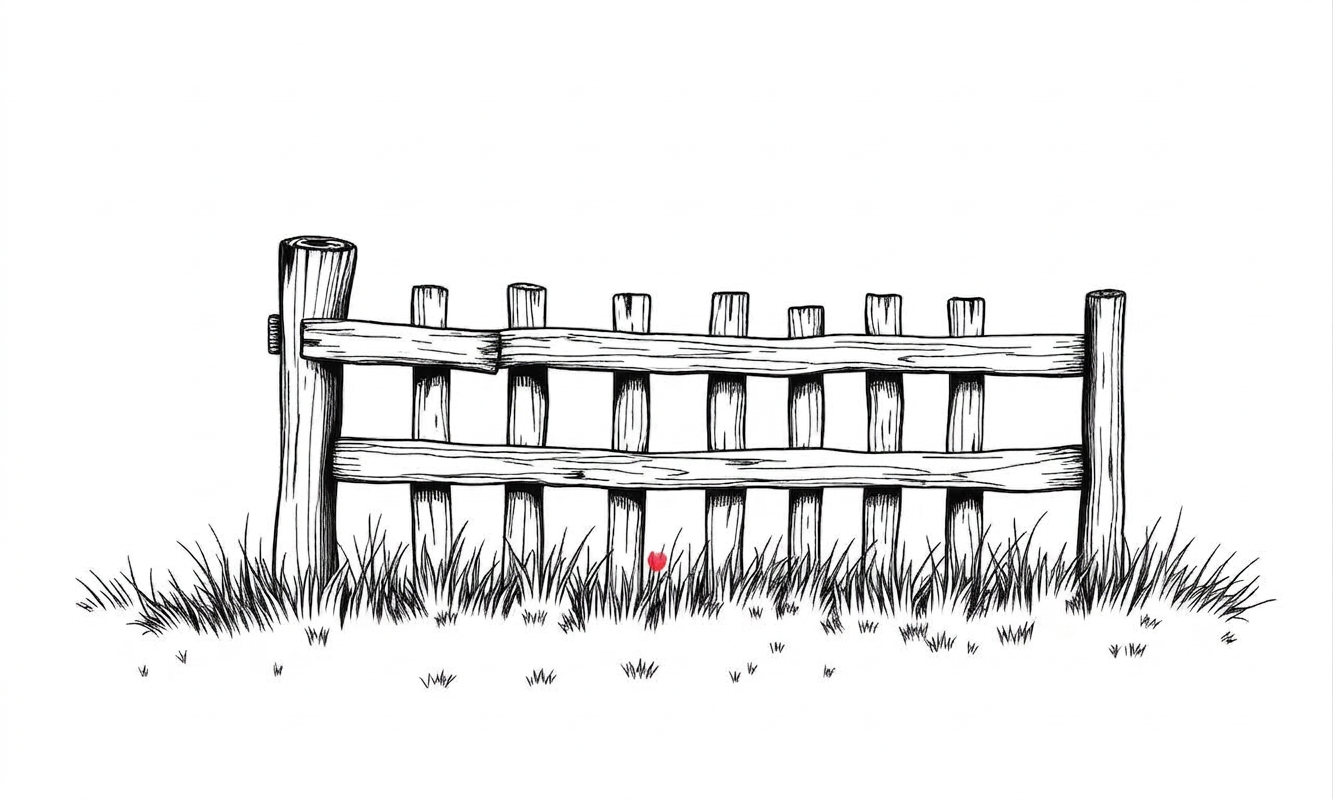
- Don't tear down a fence until you know why it was put up.
- Operating: A new VP of Product joins and immediately wants to kill three small features that 'no one uses.' Turns out each of those features is used heavily by a small set of high-paying enterprise customers.
- Investing: PE firms that buy companies and aggressively cut anything 'non-core' often end up impairing the underlying business.
- Everyday life: Newly married couples often want to redesign each other's habits.
G.K. Chesterton wrote this in 1929: "If you come across a fence in the middle of nowhere, the modern type of reformer will say 'I don't see the use of this, let us clear it away.' To which the more intelligent reformer will reply, 'If you don't see the use of it, I certainly won't let you clear it away. Go away and think.'"
The principle: most things that exist exist for a reason, even if that reason isn't obvious to you. Before removing a rule, a contract clause, a team member, a line of code, a quirky policy, ask why it was there in the first place.
People who violate Chesterton's Fence remove the thing, things break, and they discover the original reason the hard way. Sometimes it's a fence. Sometimes it's a load-bearing wall.
A few of the most common Chesterton's Fence violations in business:
- A new ops manager removes a manual quality-control checkpoint because it seems redundant given the automated checks. Three months later, customer returns spike. The manual check was catching things the automation missed.
- A new owner removes a quirky long-standing policy ("we always close at 3pm on Fridays") and revenue drops. Half the best customers came in on Friday afternoons because they trusted the reliability.
- A new CEO cancels an annual ritual that "isn't strategic." Two years later, key talent has drifted away. The ritual was what made people feel like part of something.
- A new engineer deletes a strange-looking line of code. Production goes down. The line was handling a rare edge case that nobody had bothered to comment on.
The corollary: sometimes the original reason has disappeared. The cattle are gone, the field is plowed, the fence is now actually pointless. In that case you can safely remove it. But you can only know that if you understand why it was there.
The deeper habit Chesterton's Fence builds: humility about what you don't know about an existing system. Walking into a company and assuming everything weird is irrational is the fastest way to break something important. Walking into a company and asking "why is this here?" before changing anything is slower but vastly more effective.
A useful test before removing anything: "Can I clearly state what would be different if this had never existed?" If the answer is "I'm not sure," don't remove it yet.
Examples in the wild
A new VP of Product joins and immediately wants to kill three small features that 'no one uses.' Turns out each of those features is used heavily by a small set of high-paying enterprise customers. Killing them would have lost roughly a third of revenue.
PE firms that buy companies and aggressively cut anything 'non-core' often end up impairing the underlying business. The seemingly inefficient stuff was sometimes the reason customers stayed. Chesterton would have advised more research before the chainsaw.
Newly married couples often want to redesign each other's habits. 'Why do you always do X?' If the answer is 'I don't know, I just always have,' you may be looking at a Chesterton's Fence. Investigate before reforming.
Chesterton's Fence is one of the mental models we apply through real cases inside the Pareto MBA — a part-time program for professionals who want to think clearly about business.